

Our CEO, Ronnie Wooten, looks back on three decades of Suntell: the credit file that had legs, the road trips, and the people who built it, back when the whole office shared a single internet cord.
In 1998, I was the credit administration manager at a bank. To explain that job, I have to tell you about the file.
Every customer had one.
It was thick. It was heavy. And it appeared to have legs.
If the borrower had a complex relationship, there might be several files, which meant moving them was less office work and more small warehouse operation.
Every new loan request meant the file started traveling.
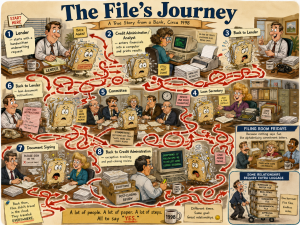
That was one new loan request. And do not get me started on annual reviews, which ran the same circuit again, every year, on every credit in the portfolio.
The same borrower information got written, typed, printed, retyped, and keyed into a different system at nearly every stop: loan terms, financials, collateral, deposit balances, covenant details.
We had computers. They just did not talk to each other.
So we became the connection.
One handwritten request, one printed report, one keystroke at a time.
And when someone needed the file, step one was figuring out which lender’s office it had wandered into.
Nobody thought this was strange. It was just how loans got made. It took days. When credit administration got backed up, it took weeks.
Then I interviewed at Suntell, and they demoed their product for me. It was called the Loan Management System (LMS).
I sat there running down my own week. This replaces the handwritten credit action memos. This replaces the separate program we used for spreading. This replaces the standalone system we used for document tracking. Deposit balances, loan balances, and terms came straight from the core, current, without anyone looking them up, writing them down, and keying them in again. Lenders could type directly into the system instead of writing it out for someone else to type up. Steps that had always waited in line behind each other could happen at the same time. Control moved to the people actually making the loan.
And I would not have to walk twelve miles a day looking for credit files.
One piece after another of what my group did by hand got pulled into one place, and it landed on me that the system was becoming the process, instead of the process pushing paper around the building.
I believe my exact words were “wow” and “incredible.”
They did not offer me the job. That day.
I had seen enough to know what they were building, so I kept after them. Somebody inside went to bat for me. Eventually they changed their mind.
Suntell had been founded two years earlier by commercial lenders who had seen the same thing I had. Outdated, manual processes were slowing lending teams down. Duplicate data entry, disconnected systems, endless checklists. The vision was simple. Bring the process together and give financial institutions a better way to manage it.
“A better way” looked a little different back then.
The internet was not in our pockets. Remote support was not much of a thing. And if you needed to research a regulation, you did not Google it. You pulled out a giant binder, cleared your afternoon, and hoped the answer was somewhere before page 900.
We had exactly one internet cord, and we took turns using it. I realize that sounds made up. It is not. If someone else was online, congratulations, you were not.
If you are too young to have ever heard a dial-up modem connect, ask a coworker over 40 to make the sound for you. They can. It is burned in permanently.
Customer support ran on a wall phone with a cord so long we could drag the receiver out of one room, down a hall, and into another to reach whoever was helping the customer. So, technically, we had mobile support. It was just attached to the wall.
Sales was hands-on, too. The team drove town to town, walked into banks, and demoed on laptops. No automated campaigns, no polished webinars. Just a laptop, a lot of miles, and the nerve to walk in and ask for someone in lending.
Training was even more glamorous. In the early years we would load up computer towers, tube monitors, keyboards, and mice, drive to the customer, and build a temporary computer lab in their conference room. Before we could teach the software, we often had to teach the mouse. Nothing says “modern software company” quite like carrying a tube monitor across a parking lot and hoping nobody asks if there is an easier way. Updates went out on floppy disks, and manuals were printed by the thousands of pages, spiral bound, and mailed.
Eventually we upgraded to laptops, which felt wildly advanced and finally ended the tube monitor era. We shipped them in sturdy locked cases for protection, and the cases we used were gun cases. So there was a stretch where our people were walking into one bank after another carrying what looked, to everyone watching, like a stack of gun cases. Not the first impression you hope to make at a financial institution.
Over the years, Suntell kept evolving. We introduced Suntell Document Imaging, which meant the documents could live in the system instead of a filing room. Back at the bank, our Friday routine had been to recruit anyone who was not busy to come help us file stacks of paper back into the credit files. Nothing says “efficient lending operation” quite like a group filing party. I would like to think we cancelled a few of those.
LMS grew into what customers now know as Square 1 Credit Suite. The tools changed. The screens changed. The expectations changed.
And the expectations are still changing. Every so often a technology comes along that feels like it changes everything. For the people who built this company, it was the internet arriving. For plenty of people reading this, it is AI right now, reshaping their world the same way the internet once reshaped ours. What changes is the technology. What stays the same is the feeling of standing in front of something big and a little intimidating, and having to figure out how to make it useful. For the record, our first “AI assistant” may have been Access Wizard, with Clippy offering moral support from inside Microsoft Word. So maybe we have been getting ready for this longer than we realized.
The tools are new, but the question is the same one we have been chasing for 30 years: how do we make a complicated process more connected, more manageable, and more useful for the people doing the work?
Some of the customers who trusted us early are still with us more than two decades later. The people who built this company left their fingerprints all over it. Some have been here more than 20 years. Others stayed for only a season and still made a lasting difference. Suntell exists because a lot of people believed in the idea before it was obvious they should.
Somehow, 28 years after I first walked in, I find myself at the helm. I still believe in what I saw in that room in 1998. But that is not really the story.
The story is the customers who saw the value early, the employees who carried the work forward, the people who supported the company, and the stubborn belief that lending teams deserved a better way to work.
Thirty years later, the technology is different. Thankfully, so are the phones, the monitors, the manuals, and the internet cords. But the heart of Suntell is still the same: solve real problems, support the people using the software, and keep finding better ways to help financial institutions do their work.
That old credit file may have finally stopped wandering from desk to desk, but the work of making the process easier, smarter, and more connected is still what drives us.
So to anyone who ever carried a tube monitor across a parking lot, bound and mailed a manual, waited their turn for the internet cord, carried a gun case into a bank, taught someone how to double click, trusted us early, challenged us to improve, or helped move the vision forward: you helped build this place.
To our customers, employees, former employees, partners, and supporters: thank you for being part of Suntell’s first 30 years.